Biological Aging
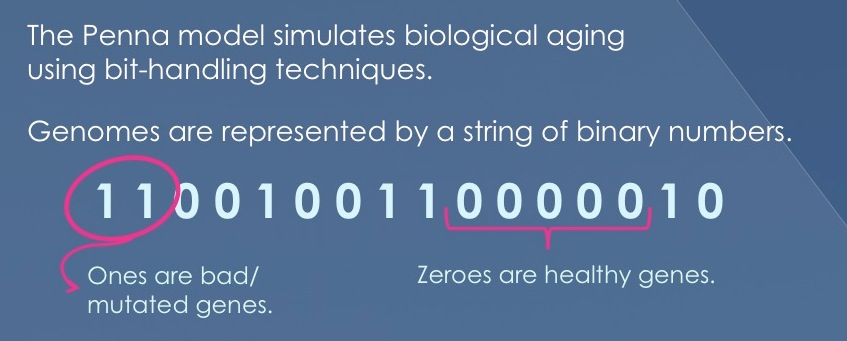
"We model population growth or decay using mutation accumulation as the mechanism for aging. A convenient quantitative model of this is the Penna bit-string model of biological aging. "
(Graphics by C. Piñol)
"Most, if not all, population models incorporate the concept of a "carrying capacity". The quantitative estimate for the carrying capacity for a population is not easily determined, nor is it very well defined. In most cases it is treated as a scaling parameter for the population whose main purpose is to keep the simulated population finite. We choose to consider cases for which this ill-defined parameter (carrying capacity) is not essential. We believe that this case is that which is most relevant to biological population studies. Resources are not explicitly accounted for in observed populations."
"A Penna model with a short bit-string length was implemented to simulate an aging population. It was found that the simulated population saturates when the minimum reproductive age is varied between two values, each of a particular period, when the lower minimum reproductive age is given a longer period."
"We are thus able to obtain a finite simulated population without having to impose the concept of a carrying capacity. This instance is added to the relatively trivial case of setting the minimum reproductive age to a value of one offspring just before death. A modification of the Penna model offers a framework for which the carrying capacity is not essential in the simulation of a biological population."
References:
- C.M.N. Piñol and R.S. Banzon, Stability in a population model without random deaths by the Verhulst factor, Physica A (2010),
doi:10.1016/j.physa.2010.11.046 [preprint] - C.M.N. Piñol and R.S. Banzon, Catastrophic senescence and semelparity in the Penna aging model, Theory in Biosciences (2010),
doi:10.1007/s12064-010-0115-7 [preprint]