Since 2004, a number of graduate and undergraduate students were able to successfully complete and defend their theses in the various research areas of SanD.
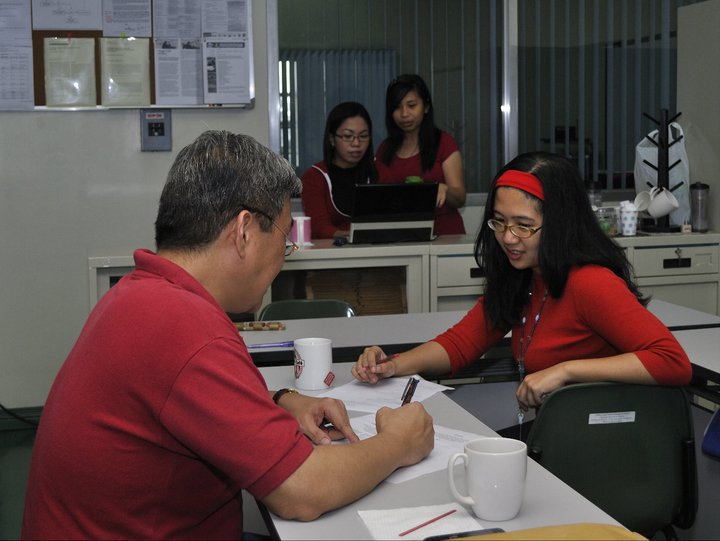
At SanD, students have regular
research meetings with their respective thesis supervisor throughout each semester.
SanD provides (i) adequate
computational facilities and resources, (ii) training in writing algorithms, and (iii) sufficient practice in writing quality scientific papers. Furthermore, SanD conducts weekly seminars
and encourage members to actively participate in scientific conferences related to their research.
Research is to see what everybody else has seen, and to think what nobody else has thought. -Albert Szent-Gyorgi
Expectations
SanD believes that working in physics and multidisciplinary fields require a solid foundation in the basics. Hence, SanD is in no rush to recruit students in the early stages of their bachelor or graduate studies. It is best for the students to first adjust to the rigors of their core courses and focus their energies in learning (i) the fundamental principles in classical and quantum mechanics, statistical mechanics, electromagnetism and solid state physics, (ii) the mathematical methods in physics, and (iii) numerical analysis.
It is thus ideal for undergraduate students to have completed their Physics courses in classical mechanics, electromagnetism and quantum mechanics (Physics 121, 131 & 104 or 141). Graduate students must have a current GWA of 2.0 or better and must have passed Physics 221 (Classical Mechanics I) and 231 (Electromagnetism I). They should be enrolled in or have passed Physics 241 (Quantum Mechanics I). Having computational skills are an advantage but are not required. In SanD, students are expected to learn and code in FORTRAN. Depending on the topic, other computer languages and mathematical software packages are used only to assist students in their research.